


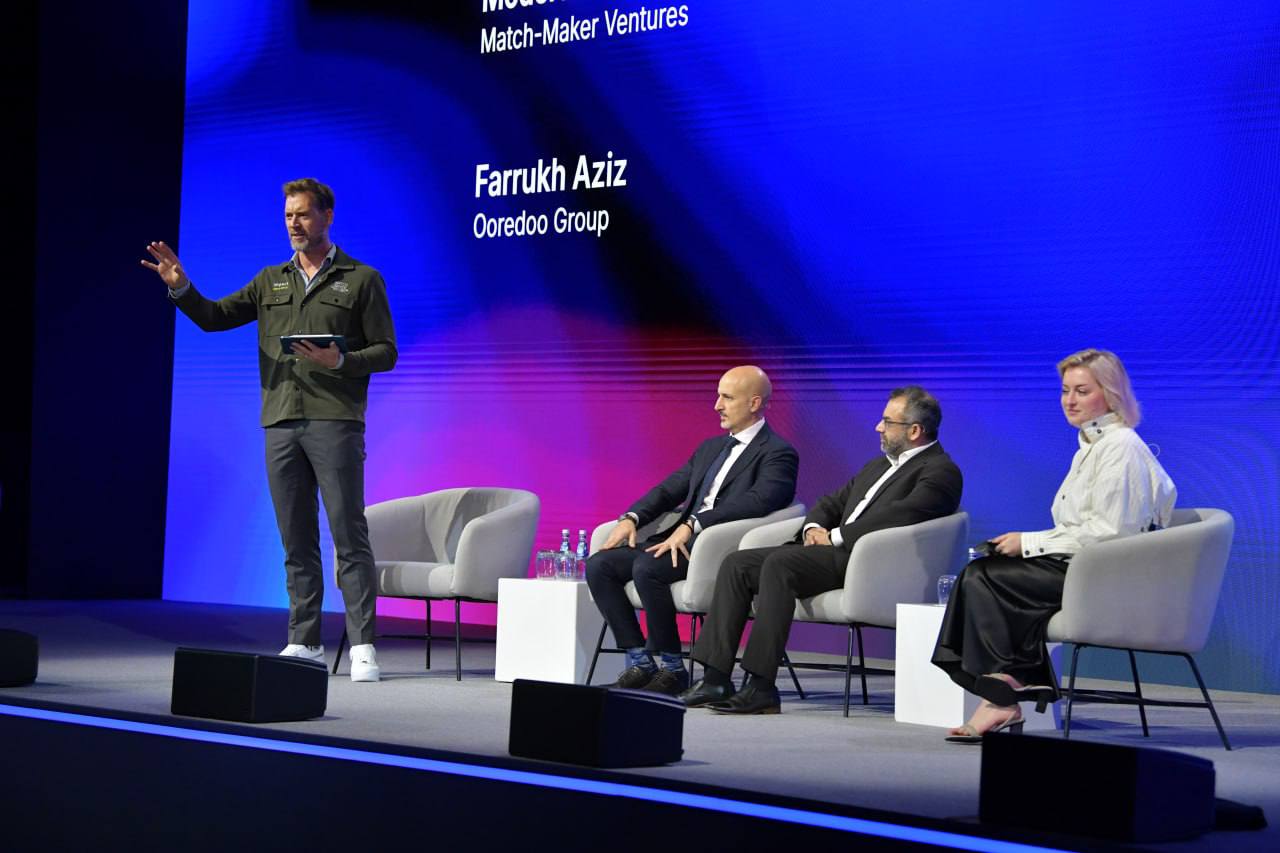
The key themes of the Summit, held on November 10 as part of the MWC Doha program, were:
• Practical examples of AI implementation
• Operational transformation of companies
• Infrastructure for scaling smart systems
• Agentic AI and industry solutions
• Regional experience and global trends
The panel discussion at the opening session of the AI in Action Summit focused on the Persian Gulf region and was designed to answer a pressing question: why do some AI pilots demonstrate high economic efficiency while most do not?
Mr. Nikolai Schattgen, CEO of Match-Maker Ventures, moderated the discussion.
The discussion was attended by:
• Mr. Eyad Baddar, Director of Presales Solution Architects (Gulf Region) at Dell Technologies
• Mr. Farrukh Aziz, Senior Director for Analytics, Customer Value Management (CVM), AI, and Pricing at Ooredoo Group
• Ms. Maria Bolshakova, Deputy Director General of the RCC
This mix of speakers allowed the question to be discussed from different angles:
• The common characteristics of projects that have reached industrial operation, along with the infrastructural and competency prerequisites for scaling them, including an assessment of how long it will take agentic AI systems to reach economically significant applications
• Assessment of the return on AI investments, criteria for stopping and scaling projects, and distribution of budget responsibility
• Regulatory conditions for technology diffusion: the impact of regulatory predictability on scaling rates, institutional prerequisites for the autonomous functioning of AI agents, and an external view of the Persian Gulf region
"Regulation slows AI development only when it is unpredictable. Clear, stable rules — even strict ones — do not hinder scaling; it is uncertainty that holds it back. That is precisely why our region is working on common basic principles that can be relied upon across different markets," noted Ms. Maria Bolshakova
⠀
For the latest RCC news, subscribe to our official Telegram channel.