


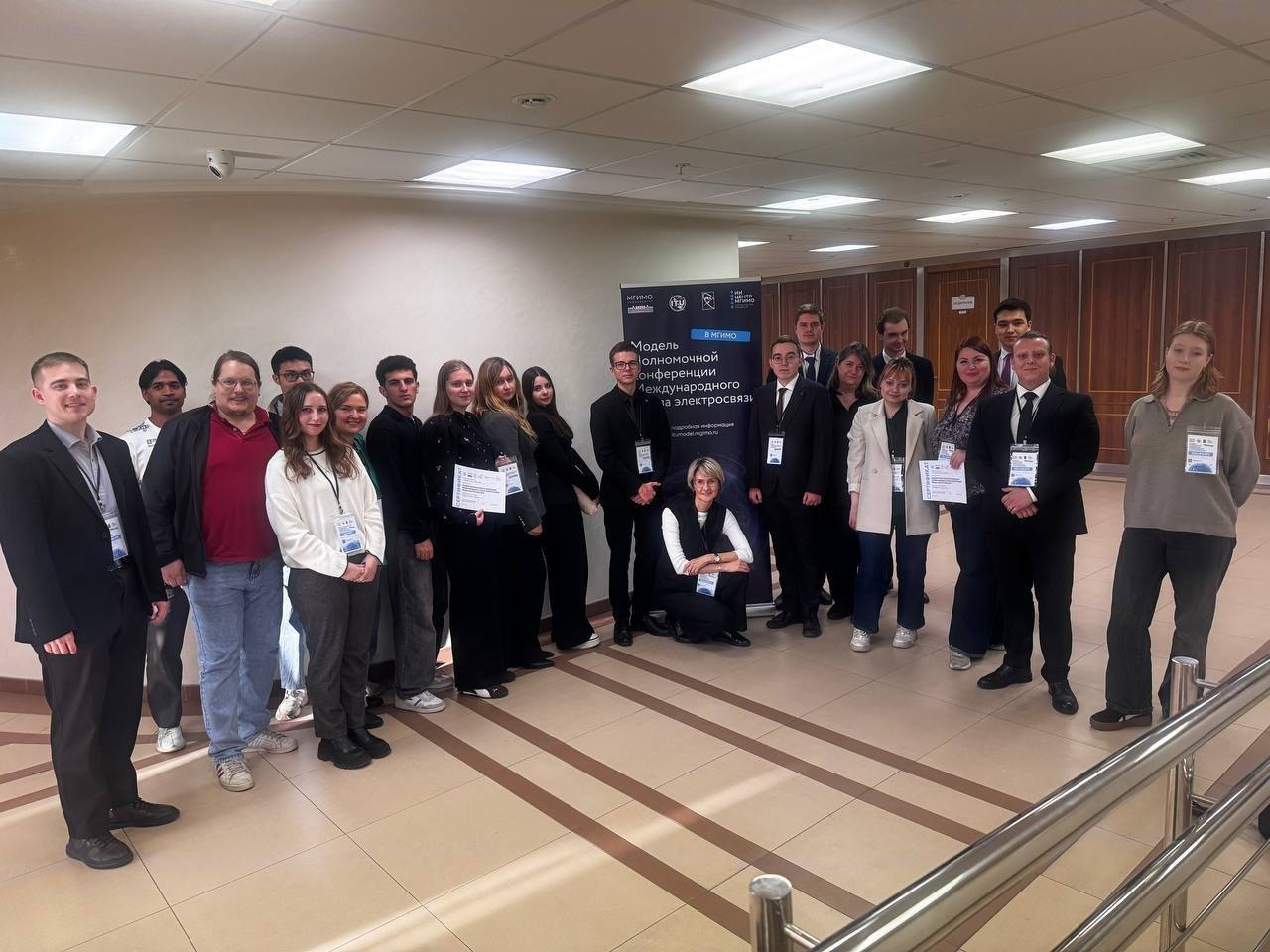
From October 26 to 28, participants of the MGIMO ''ITU Model'' went through the full cycle of multilateral negotiations — from presenting national positions to agreeing on the revision of a Resolution and holding elections for the Union's leadership.
The event was organized by the MGIMO AI Center, together with the MGIMO–MIPT Master's Programme in Artificial Intelligence.
Scientific and organizational support for the project, including lectures for the preparatory stage, was provided by:
• The Regional Commonwealth in the Field of Communications
• The Ministry of Foreign Affairs of the Russian Federation
• The Ministry of Digital Development, Communications and Mass Media of the Russian Federation
• The International Telecommunication Union
• The Bonch-Bruevich Saint Petersburg State University of Telecommunications
• The M.I. Krivosheev National Research Centre for Telecommunication (NRCT)
One of the central elements of the Model simulation was the debate on revising the text of Resolution 214, ''Artificial intelligence technologies and telecommunications/information and communication technologies,'' of the ITU Plenipotentiary Conference.
During intense discussions, three simulated negotiating groups — reflecting the approaches of Western states, BRICS countries, and the Global South — proposed amendments, defended their interests, and sought common ground.
The participants represented the positions of 25 states, including China, India, Brazil, the USA, the UK, Germany, France, Saudi Arabia, the UAE, South Africa, and other countries.
The negotiations resulted in a compromise revision of the Resolution.
On the final day, participants simulated the election of the Union's five highest officials: the Secretary-General, the Deputy Secretary-General, and the directors of the three Bureaus.
The Model brought together students and young professionals from leading Russian universities, as well as the Moscow State University branch in Yerevan, giving them the opportunity to understand the technical and political-legal aspects of international digital technology regulation, master multilateral diplomacy procedures, and apply their knowledge in practice.
⠀
For the latest RCC news, subscribe to our official Telegram channel.