


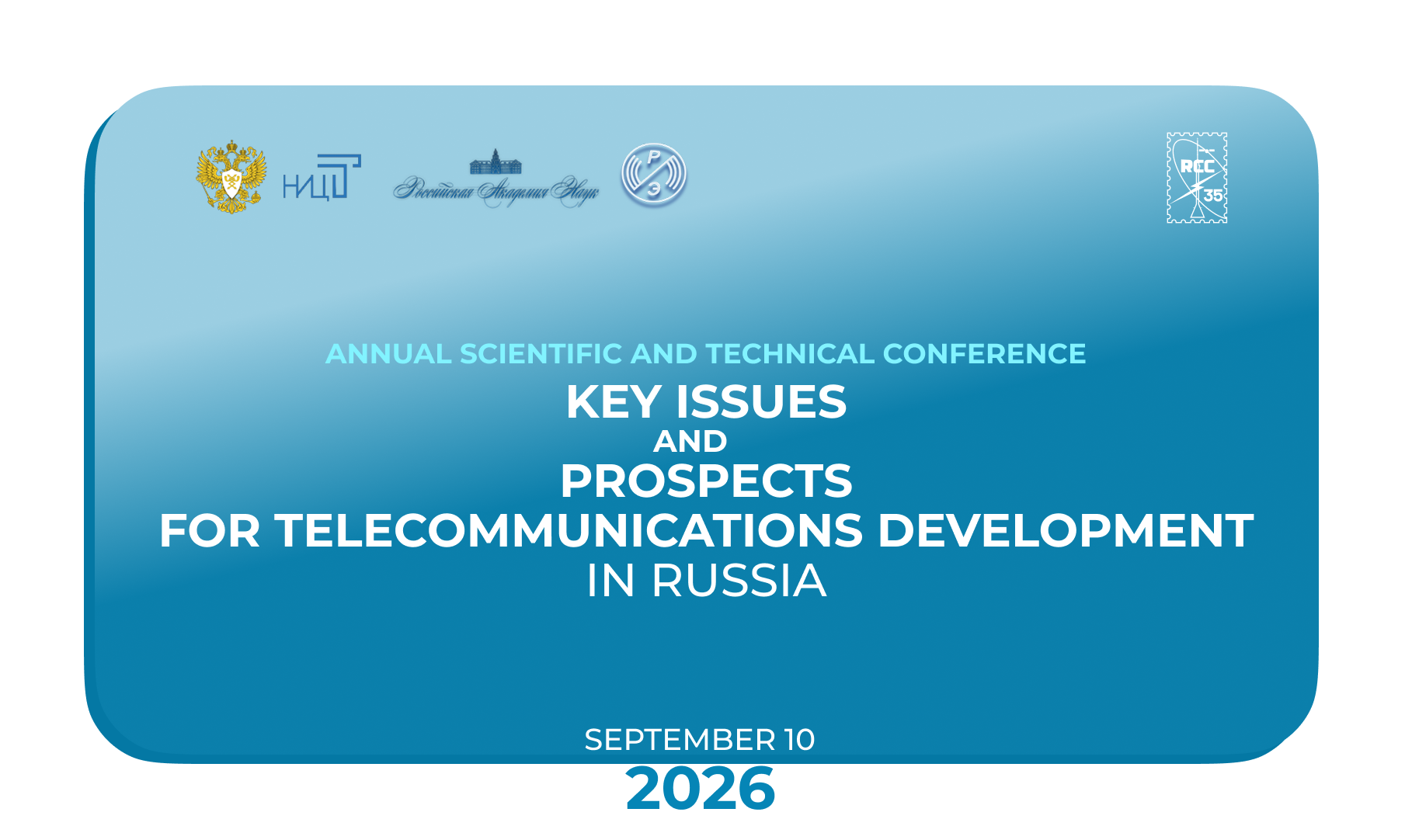
On September 10, 2026, the annual scientific and technical conference on key issues and prospects for telecommunications development in Russia was held in Moscow.
The conference was held with the support of leading scientific and government organizations in the Russian communications industry:
• The Kotelnikov Institute of Radioengineering and Electronics of the Russian Academy of Sciences (IRE RAS)
• The Ministry of Digital Development, Communications and Mass Media of the Russian Federation
• The M.I. Krivosheev National Research Centre for Telecommunication (NRCT)
• The Association of Users of the National Radio Frequency Resource "National Radio Association" (APNRR-NRA)
The event was attended by representatives of leading specialized agencies, academic institutes, higher education institutions, major telecommunications operators, and infrastructure holdings.
The Conference featured a plenary session and four specialized roundtables on the following topics:
► Satellite and Hybrid Networks
Experts examined satellite communications development and hybrid network capabilities, the current state and prospects of Roscosmos satellite systems, video communication and robotic system control in hybrid networks, as well as global trends, challenges, and development directions for Russian systems, including low‑orbit ones.
► Wireless Broadband Technologies
The focus was on the evolution of mobile networks toward 2030 and the transition to 5G/6G, including the algorithmic challenges that must be addressed for 6G. Experts separately examined the current status of 5G and 6G technologies in Russia, prospects for their deployment and development, and industrial use cases for these standards. They also presented possible approaches to creating the Russian communication and navigation system "GEOKOSMOS."
► Artificial Intelligence and Digital Services
Experts discussed the application of AI in telecom, including coordination of joint initiatives within the RCC, as well as current research directions and prospects for AI implementation. Experts examined the use of AI for managing information and computing infrastructure and for shaping the changing paradigm of communication network management, as well as trends and practical implementation of technologies in the mobile communications technical framework. Special attention was given to the transition from individual pilot projects to managed autonomy in telecom.
► Efficient Frequency Management
Experts discussed the management and allocation of the radio frequency spectrum — including its role in ensuring national security and addressing departmental tasks, as well as the possibilities of dynamic spectrum management and the reuse of IMT terrestrial network frequencies for hybrid satellite systems DC MSS IMT in the 694–2690 MHz range. Special attention was given to the practical aspects of using the 700 MHz band and the prospects for developing TV broadcasting and communications.
In his report, "Artificial Intelligence in Telecommunications: Coordination of Approaches and Joint Initiatives within the RCC," RCC Director General Mr. Alexey Borodin focused on the Commonwealth's priority areas of work on AI within the framework of interstate coordination, on ITU standardization, as well as plans for interaction with the World Artificial Intelligence Cooperation Organization (WAICO).
⠀
For the latest RCC news, subscribe to our official Telegram channel.