


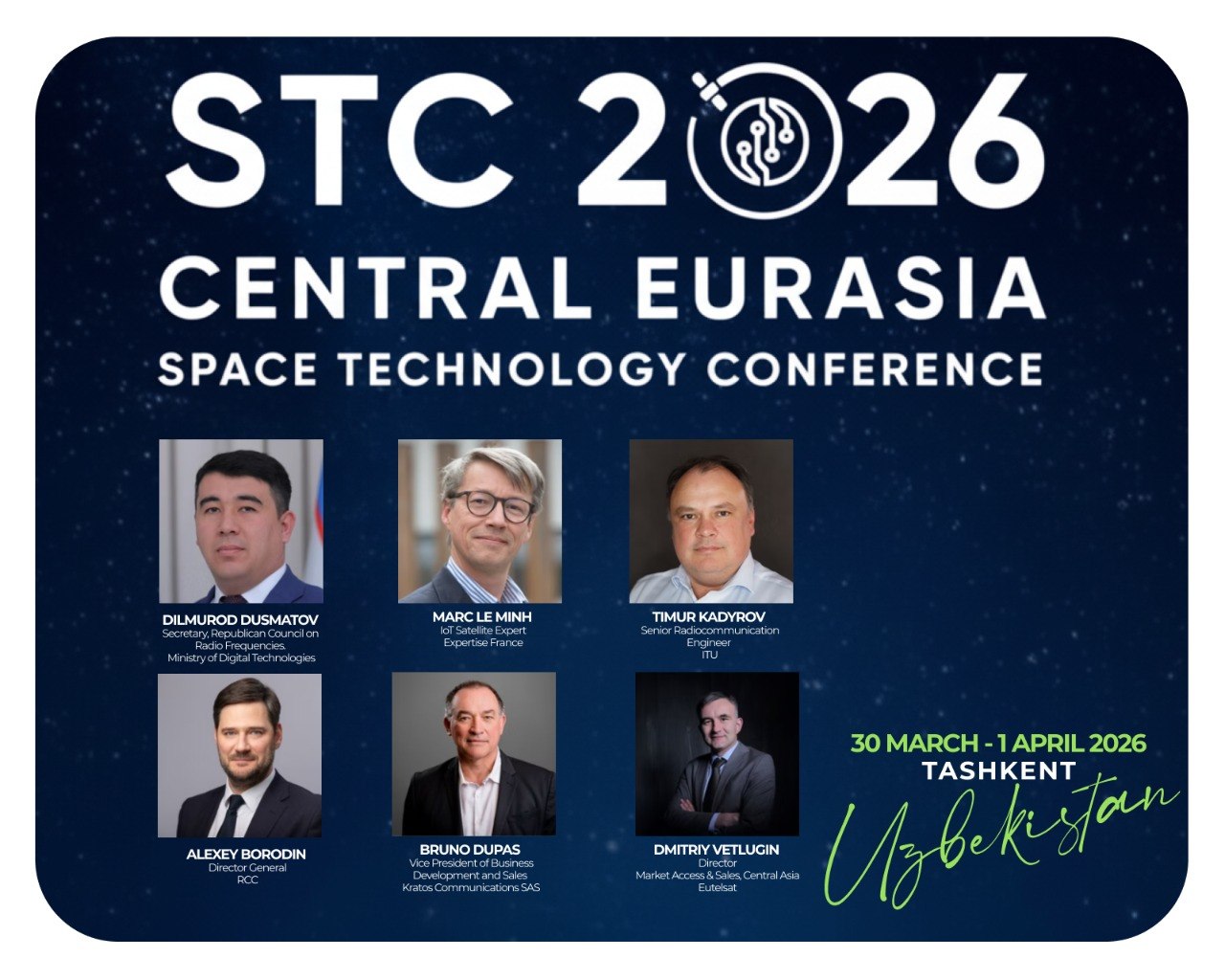
From March 30 to April 1, Tashkent is hosting the Space Technology Conference Central Eurasia 2026 (STC 2026), an international event dedicated to the development of the space ecosystem in Central Eurasia and the opportunities for international cooperation it presents.
The conference is organized by UzCosmos with the official support of the RCC.
More than 400 delegates from 32 countries are taking part in STC 2026.
The conference audience includes representatives from:
• Space agencies
• International companies
• Research centers
• International organizations
• The investment community.
As part of the STC 2026 program, a panel discussion was held on March 31. It focused on international spectrum regulation rules, national licensing, and other issues related to the deployment of D2D technology in the region.
The session was moderated by Mr. Dilmurod Dusmatov, Head of the Department of Licensing and Regulation of the Use of Radio Frequency Spectrum, Ministry of Digital Technologies of the Republic of Uzbekistan.
During the discussion, participants highlighted a number of relevant aspects of the topic, including:
• Mr. Timur Kadyrov of the ITU highlighted global regulatory risks and the specifics of applying Article 4.4 of the Radio Regulations, which affirms the right of national administrations to assign frequencies. He also noted the main vectors of the "regulatory race" ahead of the World Radiocommunication Conference 2027 (WRC‑27).
• Mr. Marc Le Minh of Expertise France spoke about the unique requirements of satellite Internet of Things (IoT) and shared his vision on how regulation can adapt to low-cost business models.
• Mr. Bruno Dupas of Kratos Communications SAS focused his presentation on a more practical area, discussing new opportunities in spectrum monitoring and state supervision of NGSO/D2D.
• Mr. Dmitriy Vetlugin of Eutelsat spoke about the evolution of national licensing approaches, focusing on measures aimed at preventing connectivity barriers.
• Mr. Alexey Borodin, Director General of the RCC, spoke about the prospects for regional harmonization of approaches within the Commonwealth. He noted that a first concrete step for RCC member states would be the development of a regional interstate agreement based on unified high-level regulatory principles.
“Such an agreement could cover aspects such as no-discriminatory access for operators to national markets, taking into account antimonopoly regulation, tax regimes, cross-border supply of communication services (including roaming), restriction of access to information prohibited by national legislation, tariff setting and settlements, dispute resolution mechanisms, and others. The key element of the agreement would be the creation of a unified interstate mechanism — or organization — by analogy with existing international space communication organizations operating on geostationary orbits,” noted the Director General of the RCC.
⠀
For the latest RCC news, subscribe to our official Telegram channel.