


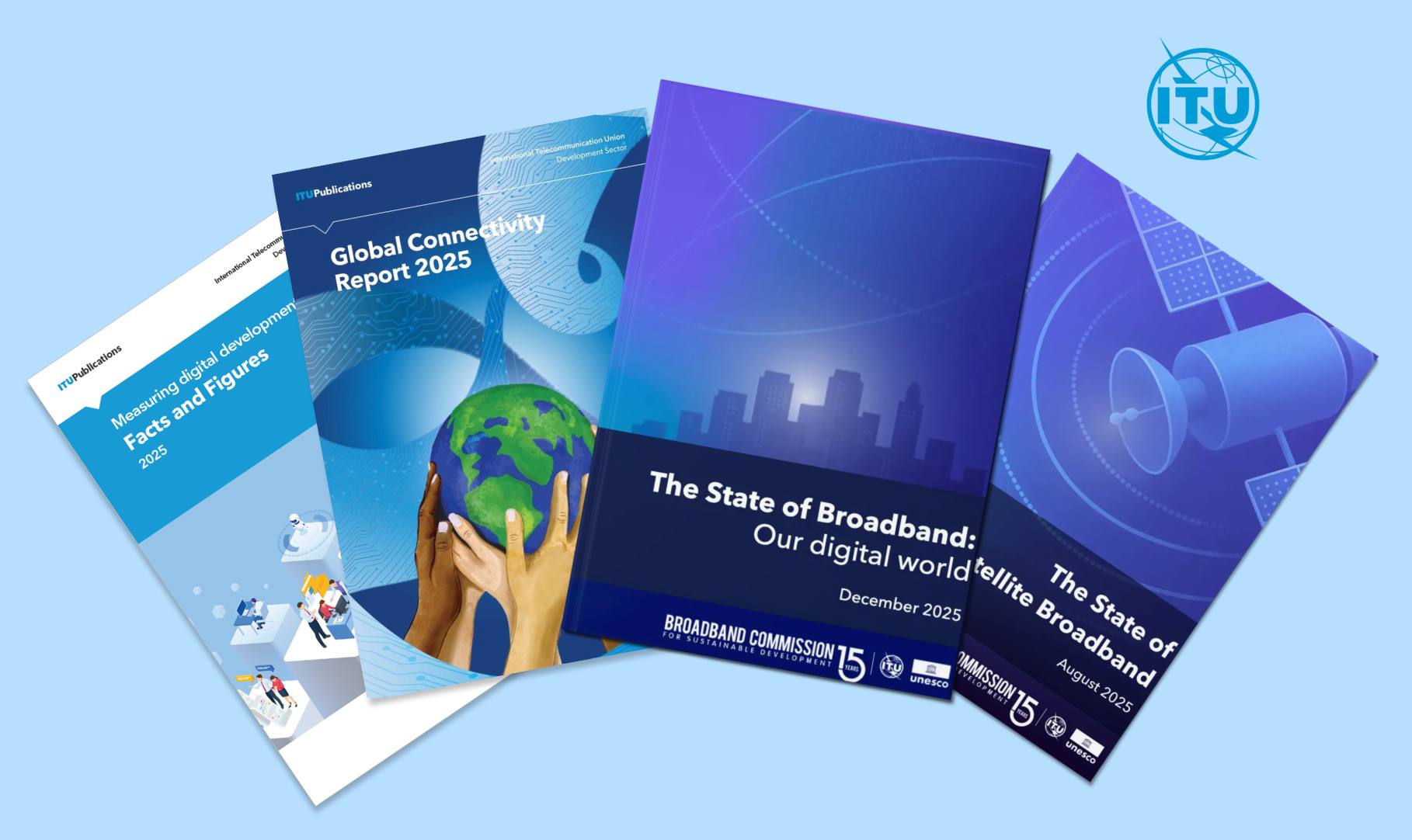
As is its year-end tradition, the International Telecommunication Union (ITU) has released a series of annual reports highlighting its work across various sectors. Notable publications include:
The report series "Measuring Digital Development: Facts and Figures" presents annual global, regional and income-group estimates for key connectivity indicators.
Key Findings:
• Approximately 75% of the world's population now uses the internet.
• An estimated 2.2 billion people remain offline, the vast majority of whom live in low- and middle-income countries.
• While 5G networks now cover over 50% of the world's population, deployment remains heavily concentrated in high-income economies.
• The gender and the rural-urban connectivity gaps are gradually narrowing but are far from being eliminated.
The digital edition of the report features interactive charts, allowing for in-depth analysis of regional trends.
The publication "Measuring Digital Development: Global Connectivity Report 2025" provides a comprehensive assessment of the evolution of global connectivity.
Key Findings:
• From a scarce resource in 1994, the internet has evolved into a critical global utility, reaching an estimated 6 billion users by 2025.
• The study evaluates connectivity based on six core criteria: quality, availability, affordability, devices, skills, and security.
• Primary barriers to development include persistent inequalities (income, gender, age, geographic location), growing online risks, the spread of misinformation, and the environmental footprint.
• Recommended facilitation mechanisms: reducing costs, developing digital skills, investing in sustainable infrastructure (e.g., cables, satellites), and fostering robust national data ecosystems.
"The State of Satellite Broadband 2025" is the second installment in the Broadband Commission's report series.
Key Findings:
• Satellite internet is experiencing rapid growth, fueled by the development of non-terrestrial networks (NTN) and an increasing number of countries engaging in space activities.
• The integration of satellite and mobile technologies, such as Direct-to-Cell and quantum sensing, is proving vital for providing connectivity in remote and rural areas.
• Potential Benefits: This expansion promises to broaden access, drive technological innovation, and contribute to achieving the UN Sustainable Development Goals (SDGs).
• Key Risks and Prerequisites: The urgent development of robust regulatory frameworks and policies, along with ensuring equitable access to space resources, is essential. Without these measures, the associated risks could outweigh the potential benefits.
As broadband becomes the backbone of our digital lives, the report "State of Broadband: Our Digital World 2025":
• analyzes the intersection of connectivity infrastructure, AI, data, and governance;
• addresses how digital services and data ecosystems are evolving and what this means for policymaking, as well as the impact on our lives.
⠀
For the latest RCC news, subscribe to our official Telegram channel.